Reading a Building Entrance on a Rainy Day
Reading a building entrance on a rainy day shows how shelter, approach and visible cues shape arrival, helping you notice what works before you step inside.
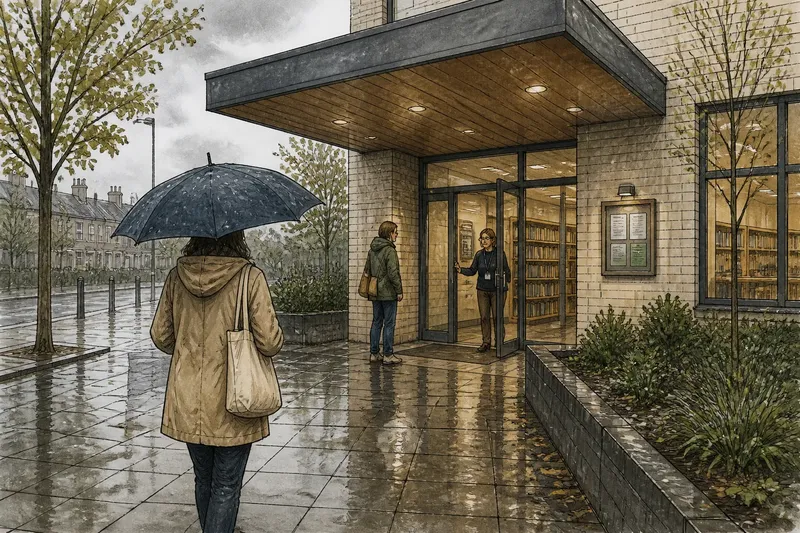
Rain gathers on the pavement as you approach a neighbourhood library, and the entrance is still several steps away. Reading a building entrance on a rainy day begins with that short stretch of wet ground: where you slow down, where you can pause, and which parts of the doorway remain sheltered.
Use an ordinary visit to notice how the entrance handles arrival rather than judging it by appearance alone. The details matter together: the route from pavement to door, protection from weather, the cues that identify the entrance, and the space available while someone gets ready to go in.
Start where the dry route begins
Imagine a clearly hypothetical visit to a small library on a rainy afternoon. You arrive on foot carrying a tote bag. From the pavement, you can see a recessed doorway beneath a projecting canopy, but the paving between the two is exposed.
Before moving closer, look for the route a visitor is being invited to take. A continuous path can be easier to understand than one interrupted by planting beds, steps or parked bicycles. Notice whether the entrance is visible from the approach, or whether a sign, change in paving or brighter doorway helps distinguish it from nearby windows.
Then follow that route at an unhurried pace. Does water collect in a low point? Is there a narrow section where people coming in and out would meet? These are observations about the entrance as it is used, not a verdict on the whole building.
Notice what the shelter actually covers
At the library, the canopy protects the doorway but not the full approach. That distinction changes the visit: you can pause under cover near the door, yet still cross an exposed patch to reach it. Look upwards and outwards to see whether shelter extends where a visitor needs it, rather than assuming that a roof over the threshold keeps the route dry.
Rain also makes the edge of a canopy easier to read. Drips may fall in a line across the paving, or wind may carry water beneath the roof. Without touching wet surfaces or obstructing anyone, notice where people naturally wait and whether they can do so without standing in the main path.
A canopy is a little like an umbrella: its usefulness depends not just on having one, but on where its coverage falls as you move. At a building, the supporting structure, wind exposure and approach all shape that coverage.
Read the ground as part of the entrance
Wet paving reveals changes that may be less obvious in dry weather. Look for the transition between public pavement and entrance forecourt: a change in material, level, colour or texture can make the route legible. Also notice whether water seems to run towards a drain or towards the doorway.
Do not infer that a surface is safe simply because it looks rough, or that a smooth surface must be slippery. Record what you can see: standing water, leaves, an abrupt level change, a mat that has shifted, or a route narrowed by objects. The point is to observe conditions, not to assess technical compliance.
In the hypothetical library visit, the paving narrows beside a planter. A person holding an umbrella has to angle sideways to pass. That detail suggests a useful question: does the entrance leave enough clear space for people to approach and pause without blocking one another?
Look for cues before you reach the door
Rain can make visitors focus on getting inside, so the entrance needs to communicate clearly at a glance. Check whether the door is easy to distinguish from adjacent glazing, whether opening hours or entry instructions are visible from a sheltered position, and whether the route leads naturally towards it.
Signs work best when they appear before a visitor has committed to the wrong route. A notice placed inside the vestibule may be too late for someone still outside in the rain. Consider sightlines from the pavement and from the point where the approach changes direction.
Watch how people respond, without treating a single action as proof of a design flaw. Someone who pauses might be reading a sign, checking a phone or waiting for another person. The useful observation is whether the entrance offers a clear place to stop without forcing others around them.
See how people share the threshold
A doorway is a meeting point for different movements: someone entering, someone leaving, and someone waiting. Rain makes those movements more visible because people may hold umbrellas, shake off water or pause to close a coat. Notice whether the sheltered area provides room for these actions while keeping the route through the entrance open.
At the imagined library, one visitor waits beneath the canopy while another opens the door from inside. The pair can pass, but the person waiting stands close to the exposed edge. The observation is specific: the doorway works as a passage, while the waiting position may be less comfortable in wind-driven rain.
Accessibility is part of this reading too. Observe whether the route appears continuous and whether the entrance offers a clear approach for people moving at different speeds or using mobility aids. Do not attempt to inspect ramps, drainage or building systems; those require appropriate expertise and, where relevant, the applicable local requirements.
How can you interpret what you notice?
What should I observe first at a rainy entrance?
Start from the pavement and trace the route to the door, noting where the path is visible, sheltered and unobstructed. Then look back towards the approach to see whether the entrance was easy to identify before you reached it.
Does a canopy mean the entrance is well sheltered?
Not necessarily: the canopy may cover only the threshold, while the waiting space or approach remains exposed. Notice where rain falls and where visitors can pause, rather than judging the roof by its presence alone.
What details are useful to record?
Write down observable conditions such as pooled water, a narrow passage, unclear signs or a sheltered place to wait. Keep those observations separate from assumptions about why a detail was designed that way.
How can I assess the entrance without interrupting anyone?
Make space for people to pass and avoid lingering in the doorway or touching building elements. A brief view from the pavement and a pause in a safe, public area can reveal plenty about the route and its cues.
Turn the visit into a useful observation
For the hypothetical library, the visit ends with a concise account: the entrance is visible from the pavement; the canopy covers the door but not the full approach; the planter narrows the route; and the waiting area sits near the canopy’s exposed edge. Each point describes something a visitor could observe, without claiming to know the designer’s intention.
If you want to compare entrances, use the same sequence on each visit: approach, shelter, ground, cues, and shared space. Keep notes short and concrete. “Water falls across the turning point” is more useful than “the entrance feels badly designed”, because it identifies a condition someone can check.
Reading a building entrance on a rainy day is most useful when you notice the transition, not just the door. The next time rain sends you under a canopy, look back along the route you travelled: that view often shows whether the building began welcoming you before you reached its threshold.